A Slightly Higher Level Problem From Combinatorics
A problem from combinatorics, slightly twisted but not very difficult.
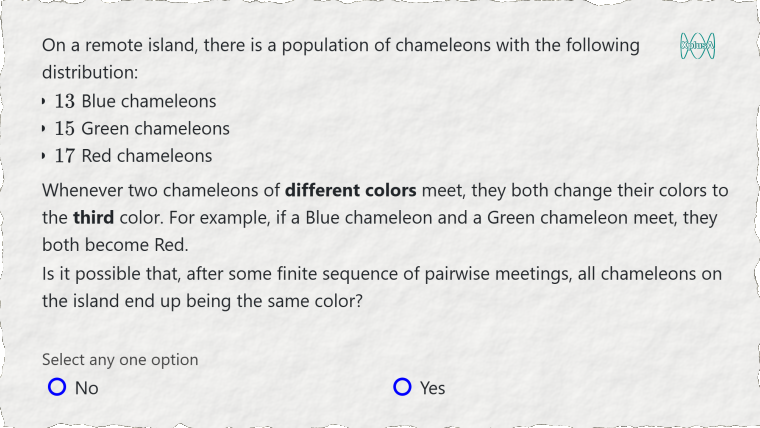
Let $b$, $g$, and $r$ denote the number of Blue, Green, and Red chameleons respectively. The total number of chameleons is $N = b + g + r = 13 + 15 + 17 = 45$.
Consider the meeting of a Blue and a Green chameleon. The population changes as follows:
We look for an invariant property modulo $3$. Let us examine the difference between the counts of any two colors, for instance, $b - g$.
After the transformation, the new difference $(b' - g')$ is:
The difference remains exactly the same.
Now consider the difference between Blue and Red, $b - r$. The new difference $(b' - r')$ is:
Thus, the difference between the number of chameleons of any two colors is invariant modulo $3$.
Initial State:
If all chameleons become a single color (e.g., all Red), the state would be $(0, 0, 45)$. The difference between the zero-count colors would be:
Since we start with differences congruent to $1$ or $2 \pmod{3}$, and the operation preserves these differences modulo $3$, we can never reach a state where the difference is $0 \pmod{3}$. Therefore, it is impossible for all chameleons to become the same color.