An Adaptation Of A 2024 Problem From The Malaysian National Math Olympiad
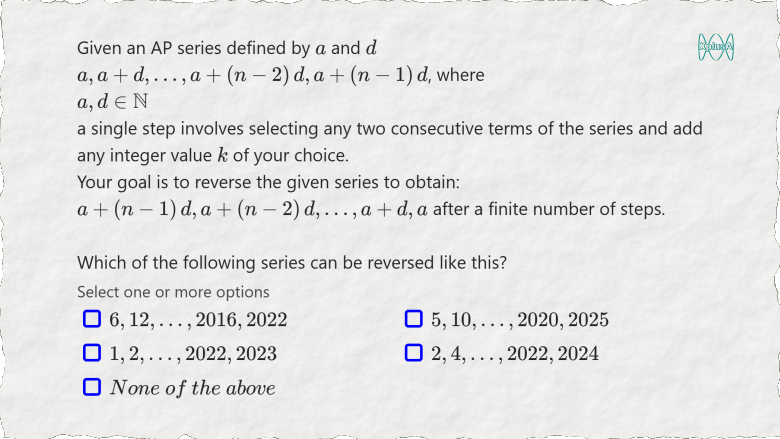
Here is an adaptation of a 2024 problem from The Malaysian National Math Olympiad.

Problem contributed by debroy0611
-----------book page break-----------
This problem can be solved using the concept of invariance.
Let us consider a series:
$\displaystyle a,a+b,\ldots,a+\left(n-2\right)d,a+\left(n-1\right)d$
Let us consider the sum of difference of alternate numbers, given as follows:
$\displaystyle S=T_1-T_2+T_3-T_4\ldots\pm T_{n}$
When you add any integer to any consecutive term, this sum does not change and remains constant.
Now let us look at the series itself. Suppose the series has an even number of terms, then the the defined sum $S$ of the orginal series is
$S_1 = a -(a+d) +...+(a + (n-2)d)-(a+(n-1)d)$ and the same sum for the reversed series will be:
$S_2 = (a+(n-1)d) - (a + (n-2)d) + ... +(a+d) -a$
Clearly $S_1 = -S_2$.
Since the defined step does not change this sum for the series (with even number or terms), the end result can never be achieved.
While if the given series has odd number of terms, we can easily see that
$S_1 = S_2$.
Therefore, even with the given invariance we can reach the target state of the array (reversed).
-----------book page break-----------
We can easily see that adding a sequence like:
$(n-1)d, -2d, (n-3)d, -4d,..., -(n-1)d$ to each successive pair
$\{T_1, T_2\}, \{T_2, T_3\}, ... \{T_{n-1}, T_n\}$ will reverse the sequence.
Therefore, any AP series with odd number of terms can be reversed using the given step, while a series with even number of terms cannot be reversed.
Of the given options:
$\displaystyle 5,10,\ldots,2020,2025$ has $\dfrac{2025-5}{5}+1 = 405$ terms ($\therefore$ can be reversed)
$\displaystyle 6,12,\ldots,2016,2022$ has $\dfrac{2022-6}{6} + 1 = 337$ terms ($\therefore$ can be reversed)
$\displaystyle 1,2,\ldots,2022,2023$ has $\dfrac{2023-1}{1} + 1 = 2023$ terms ($\therefore$ can be reversed)
$\displaystyle 2,4,\ldots,2022,2024$ has $\dfrac{2024-2}{2} + 1 = 1012$ terms ($\therefore$ cannot be reversed)