A Tricky Problem From Competitive Mathematics
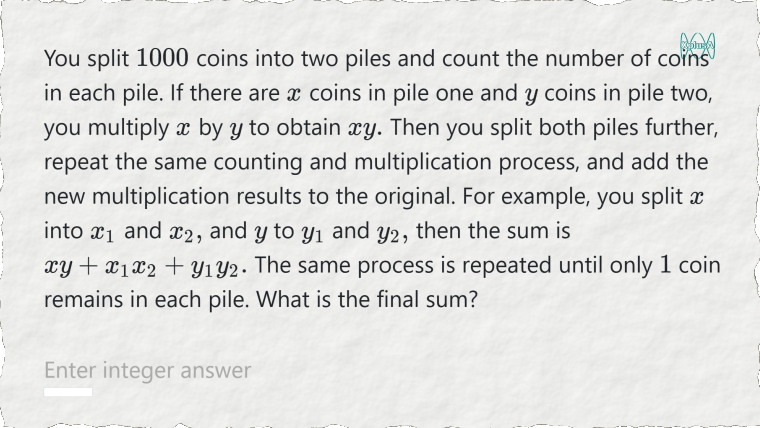
A competitive mathematics problem based on simple combination.

Imagine each of the $1000$ coins is distinct (e.g., labeled $1$ to $1000$).
When you split a pile of size $n$ into two piles $X$ and $Y$ of size $x$ and $y$ respectively, there are $xy$ possible mappings of each element of $X$ to elements of $Y$. Whereas it does not include any mapping of any element of $X$ with another element of $X$.
Next when you break up $X$ into two piles $X_1$ and $X_2$, $x_1x_2$ is the number of mappings of any element of $X_1$ with elements of $X_2$. That means, for every element $a$ of $X_1$, we created a new set of mappings with all elements of $X_2$, which are mutually exclusive of its mappings with elements of $Y$, that we had earlier.
Like this every time we break a set, we create a new set of mappings for all the elements of the new sets formed.
Finally when we have single elements in all our sets, we actually have all possible two element subsets of the initial set.
Therefore, the ways to do that is given by:
$\displaystyle\binom{n}{2} = \dfrac{n(n-1)}{2} = \dfrac{1000\times999}{2} = 499500$